0.00%

Design
Solar Design Systems: How Energy Teams Scale UX, Content, and Delivery
The solar industry is scaling fast—and software has to keep up. As portfolios expand, teams need a common system to design, ship, and evolve experiences across sites, apps, and portals. A sector-specific design system aligns brand, UX, headless content, and data so releases are faster, interfaces stay consistent, and decisions are grounded in accurate, real-time insight.
Why design systems matter in solar
Without shared tokens, components, and governance, experiences drift, existing systems fork, accessibility suffers, and teams ship slower. A purpose-built system turns scattered screens into a cohesive product surface—so you reduce design time and rework, improve usability for diverse users, and lower costs across projects and services.
Outcomes you can expect
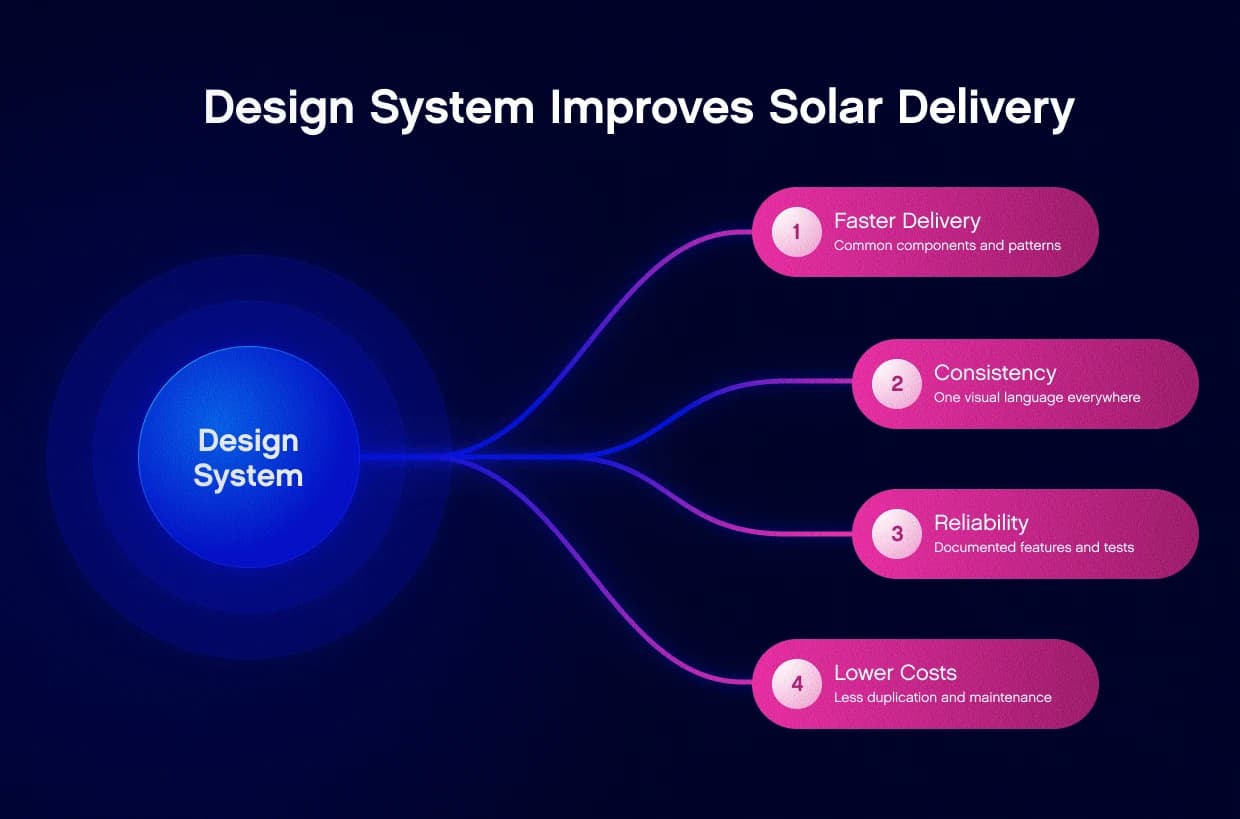
Faster delivery: common components and patterns across mobile and web.
Consistency: one visual and interaction language everywhere.
Reliability: documented features, a11y checks, and visual regression tests baked into the pipeline.
Lower costs: less duplication, fewer hand-offs, cleaner maintenance.
Robust functionality in solar design systems enables teams to streamline workflows and deliver consistent, high-quality results.
Research and Planning
The foundation of any successful solar energy management system lies in thorough research and strategic planning. Solar companies must start by conducting initial research to clearly define their needs, energy usage patterns, and the specific requirements of their solar systems. Key factors for designing effective solar energy systems include energy needs analysis, site assessment, and component selection. This step is crucial for identifying the features and tools that will deliver the most value and efficiency.
Analyzing competitors and staying on top of market trends allows companies to benchmark their systems and discover new opportunities for differentiation. During this stage, it’s important to gather input from all stakeholders—sales teams, operations, and end users—to ensure the system addresses real-world challenges and supports business objectives.
Prototyping and usability testing are essential steps in the planning process. By creating early models and gathering feedback, companies can refine their systems to be more intuitive and user-friendly, reducing the risk of costly rework later. This approach helps solar companies create tailored solutions that efficiently manage energy usage, streamline workflows, and ultimately save money while increasing revenue.
By investing time in research and planning, solar companies set the stage for a management system that meets their unique needs, supports growth, and delivers measurable results from day one.
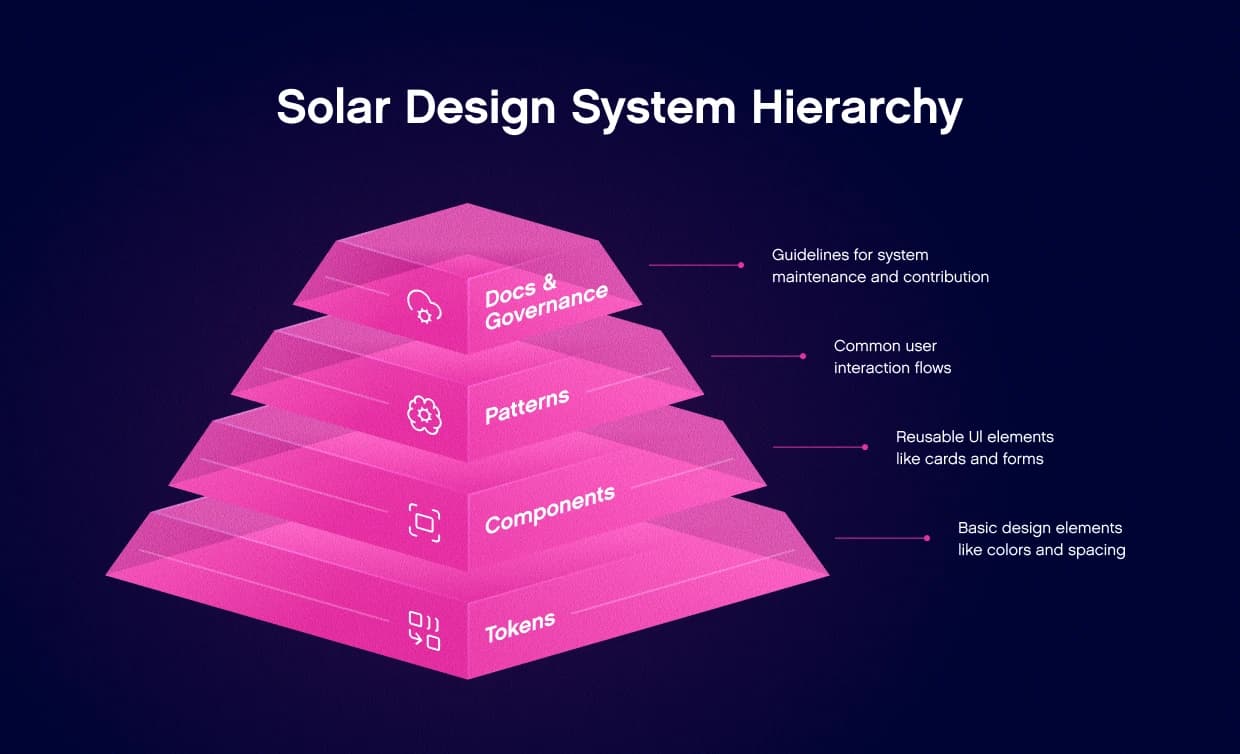
What a solar design system includes
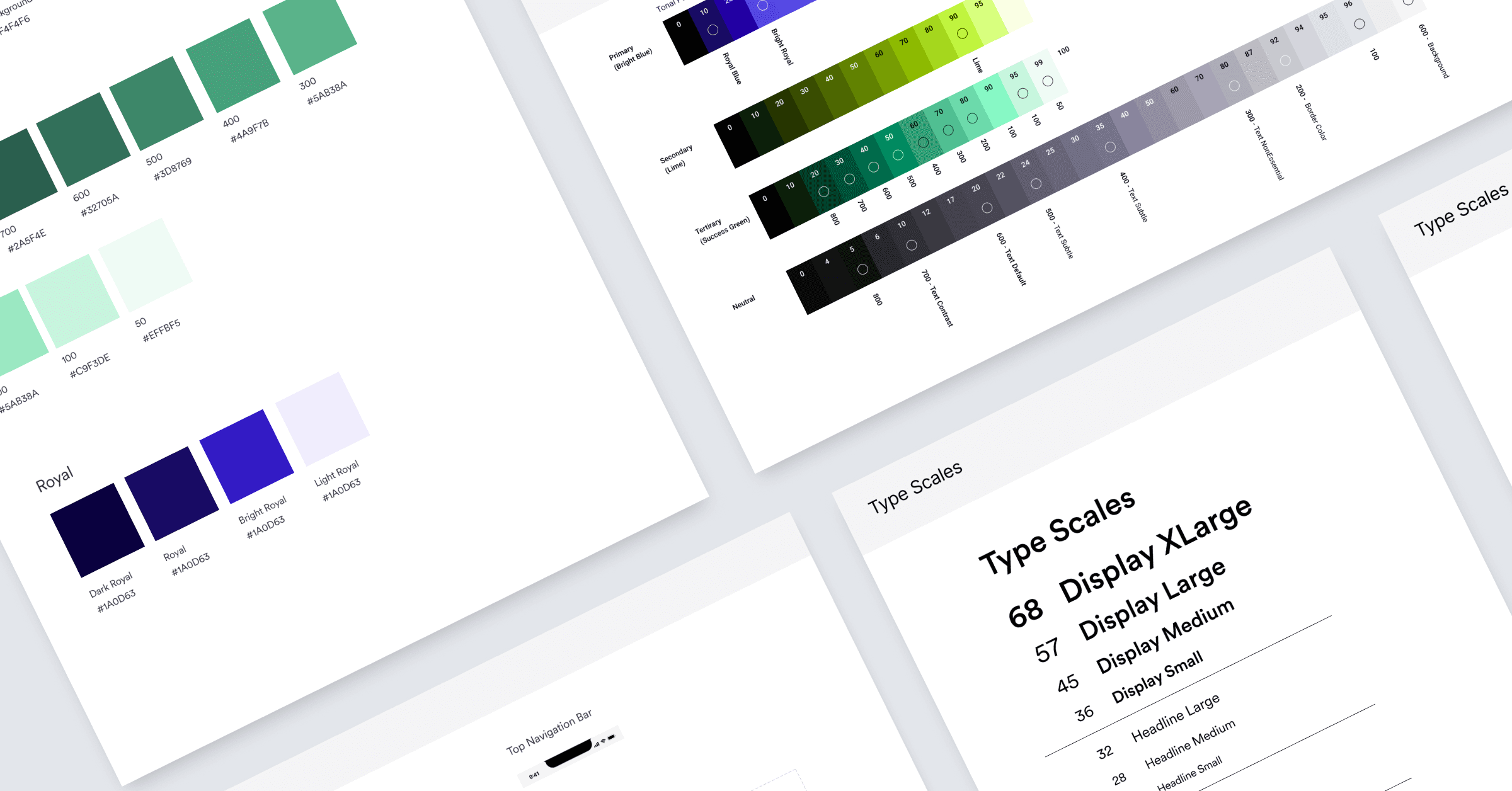
Tokens (type, color, spacing, state)
Components (cards, charts, tables, forms)
Patterns (bill upload, tariff selector, proposal flow)
Docs & governance (RACI, accessibility, versioning, contribution model)
The goal is predictable delivery and consistent behavior across tools that surface real time data on production, energy usage, savings, and service.
Lessons energy teams can borrow from SaaS
Standardize decisions. SaaS leaders scaled by turning taste and one-offs into rules and automated checks. Using the right tool is essential to standardize and automate design decisions in solar projects, helping teams streamline workflows and improve consistency.
1. Tokens → components → patterns
Start from tokens, then primitives (buttons, inputs), then complex patterns (proposal builder, tariff selector). Document variants, states, and data contracts so apps and websites stay in sync.
2. Design ops & contribution
Define who plans, who builds, who reviews. Use a lightweight RACI, PR templates, and checklists for usability and accessibility. Version releases like software; publish changelogs; sunset deprecated systems deliberately.
3. CI/CD for UI design
Automate story previews and visual diffs. Treat UI design assets like code—branches, reviews, releases—so teams create once and ship everywhere, predictably. Solar design software generally includes features like 3D modeling, automated tools, and financial analysis capabilities, which streamline the design and delivery process.
Automate story previews and visual diffs. Treat UI design assets like code—branches, reviews, releases—so teams create once and ship everywhere, predictably.
Information architecture for energy users
Great UI design starts with how information flows:
Production vs. energy usage: show “now / today / month / lifetime” side-by-side so customers connect output to bills in real time.
Drill-downs: portfolio → site → device without losing context.
Progressive disclosure: surface essentials first; let engineering and installers dive into details when needed.
A well-designed dashboard centralizes key metrics and provides users with real-time insights into their solar energy systems, making complex data easy to understand and act on.
Clear copy is part of UI design. “Power now” beats “kW instantaneous.” An intuitive interface reduces support tickets and speeds decision-making.
Mobile patterns that stick
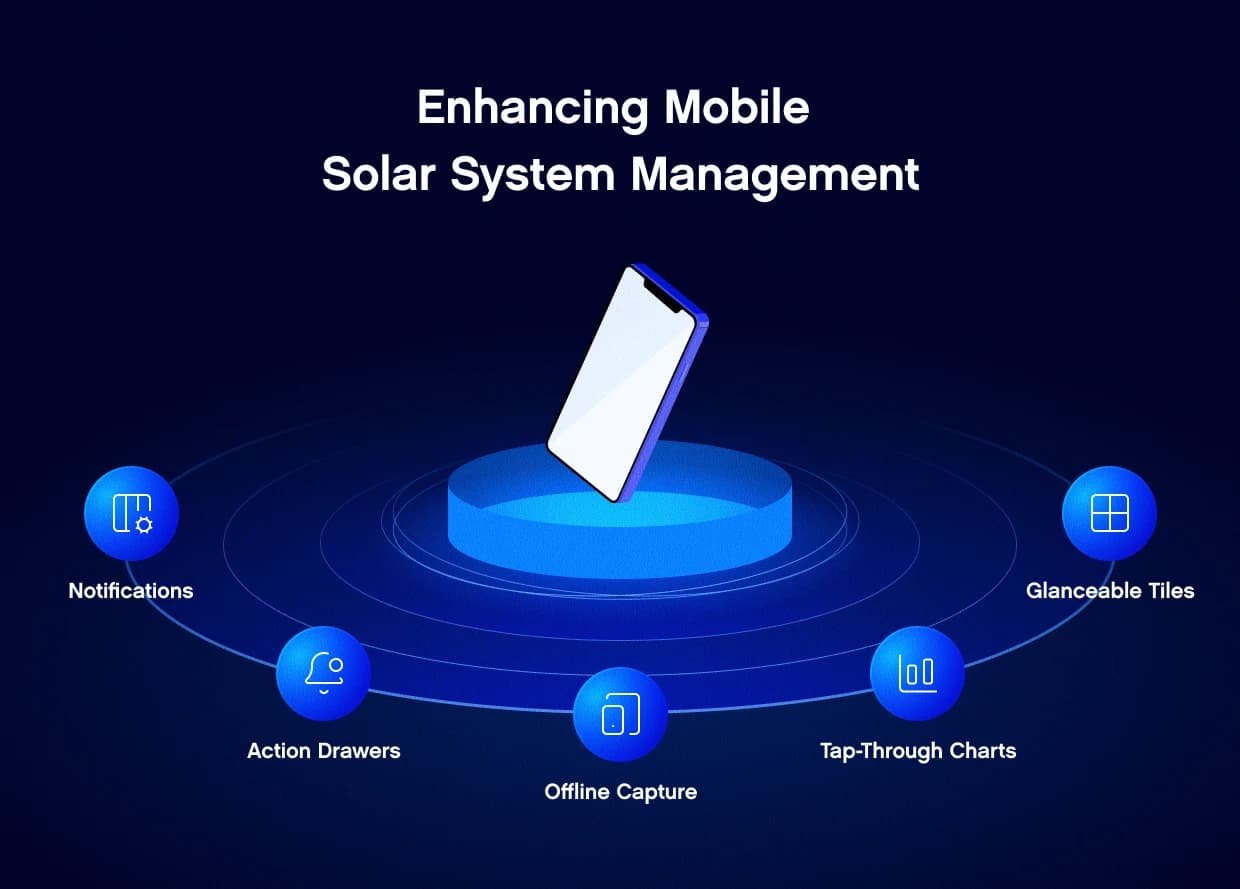
Most homeowner and field workflows happen on mobile. Prioritize:
Glanceable tiles (status, savings, energy usage)
Tap-through charts with real time data
Offline capture for field teams
Action drawers (approve change orders, schedule service)
Notifications that drive the next best step
These mobile patterns make it easier for users to manage and monitor their solar systems on the go.
Aim for the same speed on 4G as on fiber. Mobile is not “secondary”—it’s where trust is won.
Specialized components for solar platforms
Design once; reuse across apps, portals, and sites.
Automated design helpers: accurate placement and arrangement of panels in layout, tilt/azimuth guidance, obstruction masks (with human override) for optimal system performance and reduced installation errors
Tariff & incentive selector: local rates, market programs, financing
Proposal builder: scenarios, pricing, legal documents, e-sign
Savings visualizations: blend production, consumption, and bill impacts in real time
IRR/payback module: explicit assumptions, editable inputs
Service ticket card: SLA, photos, reports, timelines
These components let a sales team, an installer, and a homeowner read the same truth—through role-appropriate views.
For category context, leading tools highlight automated layouts, shading analysis, energy simulations, and proposals as standard features. Use that as a baseline for your own components and docs.
Automation and Optimization
Automation and optimization are transforming how solar companies manage their energy systems, making operations more efficient and boosting revenue potential. By automating routine tasks—such as system monitoring, data collection, and performance alerts—companies can minimize manual intervention, reduce errors, and free up valuable resources for higher-level strategy and customer engagement. Proactive system alerts in solar management applications contribute to improved user engagement and effective maintenance, ensuring systems operate at peak efficiency.
Optimization goes hand-in-hand with automation. Leveraging real-time data and advanced analytics, solar companies can identify inefficiencies, predict maintenance needs, and fine-tune system performance. Machine learning and predictive algorithms provide personalized recommendations, helping teams make smarter decisions that drive both energy efficiency and cost savings.
An intuitive UI design is critical for making these advanced features accessible. Easy-to-navigate dashboards, personalized proposals, and clear visualizations ensure that users—from sales teams to end customers—can quickly understand system status and take action when needed. This not only improves the customer experience but also supports faster sales cycles and higher conversion rates.
By embracing automation and optimization, solar companies can stay ahead in a competitive industry, reduce operational costs, and unlock new revenue opportunities—all while delivering a seamless, intuitive experience for every user.
Headless vs. monolithic for energy content
Headless separates content from presentation. Editors create rate cards, calculators, incentives, and product notes once and publish everywhere (site, portal, app). Headless architecture helps address the challenges of delivering personalized content across multiple platforms by enabling quick and accurate updates tailored to each channel. Roles, approvals, and localization keep multi-region sites consistent; APIs sync updates into product UIs in real time.
Public policy is moving the same way: interoperable, secure digital platforms are now a strategic priority for energy systems in the EU. Use that momentum to justify governance and headless upgrades.
Real-time UI that explains the “why”
Charts should teach, not decorate:
Effective UIs help users visualize the impact of their solar energy systems by making complex data easy to understand.
Merge production vs. energy usage with cost overlays.
Baseline vs. with-storage projections.
Weather context so people understand variability.
Alert cards with clear actions (“Clean string 3,” “Battery reserve low”).
If users need a walkthrough to read a chart, refactor the chart.
Accessibility, performance, and security
Accessibility: color-contrast tokens; keyboard flows; motion-reduced states; unit toggles (kW/kWh, $, €/£); multilingual support.
Performance: Core Web Vitals budgets at component level; static + streamed rendering for heavy dashboards; observability (logs, traces, user timing) on critical routes.
Security: RBAC for editors and service teams; audit logs for sensitive actions; PII minimization and clear consent; threat modeling for integration points.
EU policy explicitly calls for cybersecurity and resilience in the energy system—build those requirements into your acceptance criteria.
Integrations: your platform in the tech stack
CRM & other tools: contacts, journeys, sales stages, and proposal status
Monitoring & telemetry: inverter APIs, device data streams, alert webhooks in real time
Pricing & financing: databases, calculators, proposal exports
Billing & customer service: status, tickets, reports
Effective integrations are critical to the success of any solar project, ensuring that each system works seamlessly together to support project goals, timelines, and deliverables.
Map existing systems first, then plan deprecations. Avoid duplicating sources of truth.
Product–marketing convergence
Share one library across site, portal, and app so brand and UI design stay consistent. Keep a single backlog for development and content teams to manage requests and measure cycle time.
Unified libraries and backlogs empower teams to push the boundaries of innovation in solar design systems, driving more effective collaboration between product and marketing.
Sales enablement (without hijacking product)
Great UI design supports the sales process without turning the product into a pitch deck. Equip the sales team with explainers, calculators, and trustworthy charts so a prepared sales representative can sell complex solutions with confidence. Sales teams can learn to leverage these tools and resources to close more deals effectively. Done right, this flow helps you close more deals and boost sales—without bloating the interface.
Compliance & codes (skip folklore)
AHJ and utility requirements vary. Don’t hard-code “universal rules”; encode local constraints in configuration so proposals remain compliant across regions. When people mention the “20% rule,” they often mean local interpretations of service ratings or busbar limits, which differ by jurisdiction—always validate with your authority having jurisdiction.
It is the responsibility of solar companies to stay updated on changing codes and ensure all proposals remain compliant with the latest local regulations.
KPIs that prove impact
Reuse rate of components (%)
Time-to-publish content (minutes)
Time-to-proposal (minutes) and close conversion
Support tickets per 1k users
A11y pass rate; performance budgets met (%)
Onboarding time for new team members (hours)
Track them the same way you track uptime and portfolio yield.
90-day rollout (from inventory to v1)
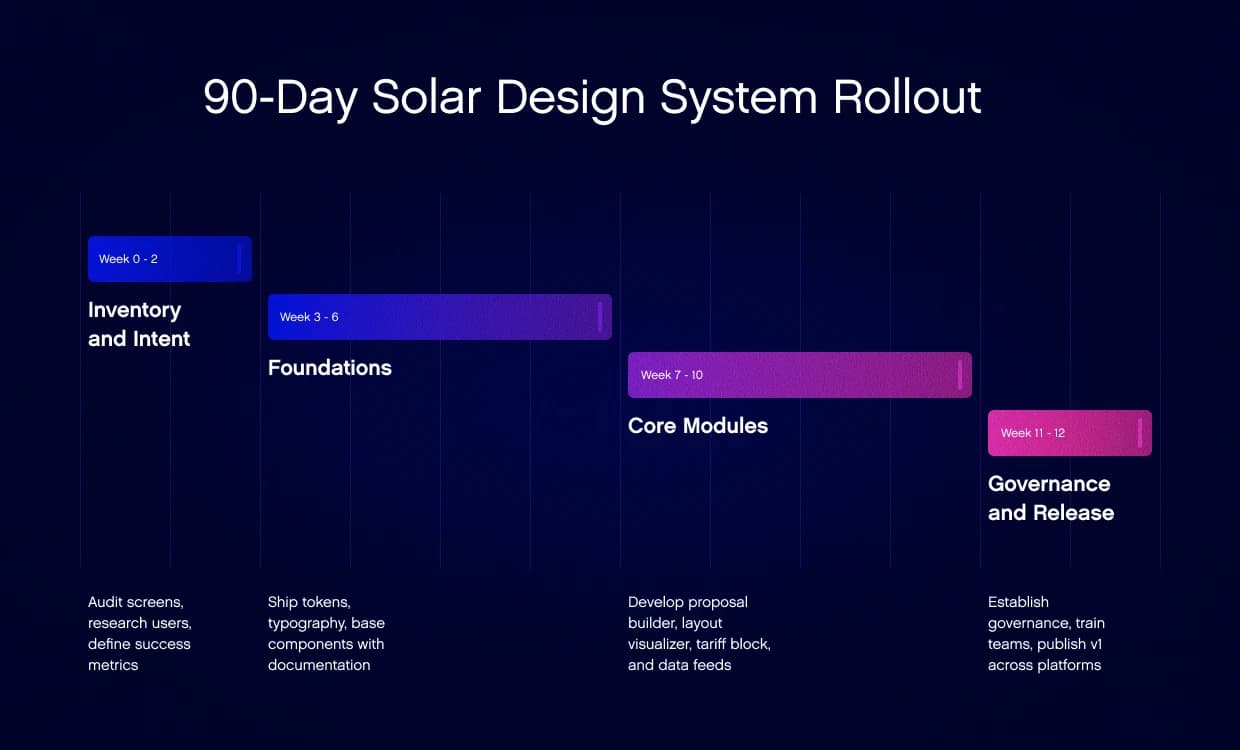
Weeks 0–2 – Inventory & intent
Audit screens, tokens, apps; interview homeowners, sales reps, and ops (user research). Define success: cut costs, save time, raise acceptance. When building a new solar design system, starting from scratch allows for a clean foundation tailored to current needs and future scalability.
Weeks 3–6 – Foundations
Ship tokens, naming, typography, spacing; base components with docs. Turn on story previews and accessibility checks.
Weeks 7–10 – Core modules
Proposal builder, layout visualizer, tariff block, incentive banners. Hook up real time data feeds.
Weeks 11–12 – Governance & release
RACI, contribution guide, changelog, sunset plan for duplicate systems. Train the sales team and ops; publish v1 across mobile and web.
Conclusion and Business Case
A strong system turns strategy into scale. It helps teams create faster, optimize experiences, save time, and reduce rework. It also keeps apps, sites, and portals consistent so customers actually understand the value of solar energy and move forward. A successful design system is built to support both residential and commercial solar projects, ensuring flexibility and effectiveness for a wide range of applications.
FAQ


About Matic
We're a B2B transformation agency creating strategic advantage through branding, websites, and digital products.