0.00%

Design
How to Redesign a Website in 2025: A Strategic Guide for B2B Growth
Websites aren't online brochures anymore, they're mature functional software that businesses either find or defer interested parties. It’s where clients form their first impression of your brand, validate your expertise and decide whether to take the next step. In 2025, more than 60 % of web traffic comes from mobile devices and 94 % of first impressions are driven by design and usability . For B2B brands, an outdated or confusing site signals stagnation and undermines trust. An outdated design can negatively impact perception, user experience, and credibility, making it harder to engage visitors and improve search rankings.
At Matic, we’ve seen organizations thrive when they lead with strategy rather than aesthetics. Strong brands aren’t just well‑known – they’re deeply believed in . That belief comes from aligning who you are on the inside with what visitors experience online. As a B2B transformation agency, we help companies create strategic advantage through branding, websites and digital products . The following streamlined framework combines best‑practice UX, SEO and brand strategy to help you redesign your website for long‑term growth.
What is a website redesign?
A redesign isn’t just a fresh coat of paint. It’s a comprehensive overhaul of your site’s architecture, content and technology to better serve users and advance business goals. A true redesign touches everything: information hierarchy, navigation patterns, copy, visuals, performance and integrations. A redesign involves comprehensive planning of content, structure, and functionality to ensure alignment with business goals and to improve user experience. Unlike minor updates or a “facelift,” a redesign examines the why behind your site — why your audience visits, why they convert (or don’t), and why your site exists in the first place. At Matic we treat redesigns as part of a broader transformation: an opportunity to revisit positioning, voice and overall brand experience.
Website redesign vs. website refresh
Sometimes you don’t need to rebuild from scratch. A website refresh updates surface‑level elements like fonts, colors and imagery while leaving your core structure and technology intact. It’s ideal when your site is performing well but looks dated or when you need seasonal updates and campaign‑specific changes. A redesign, by contrast, addresses deeper issues such as slow performance, poor mobile experience, outdated tech stack, confusing user journeys or shifts in your business model. In cases where your website requires extensive modifications and infrastructure replacement, a complete overhaul may be necessary, similar to renovating a house from the ground up, rather than making minor updates. Most B2B organizations benefit from a minor refresh every year and a full redesign every 3–5 years.
Why consider a website redesign?
Evaluate your current website first. Before deciding on a redesign, assess your current website’s usability, performance metrics, and how well it aligns with your business goals. This analysis helps determine if an overhaul is necessary and where improvements will have the most impact.
User experience drives conversions. Poor navigation, slow pages or unclear messaging push prospects away. A well‑executed redesign can improve conversions by 20–50 % and reduce bounce rates, dramatically increasing revenue.
Mobile traffic now dominates. With most visitors arriving from phones, your site must be responsive and fast. Google prioritises mobile‑friendly sites in search results.
Your brand evolves. As your positioning or services change, your website should reflect your current value proposition and expertise. Refreshing visuals and messaging keeps you credible and relevant.
Technology moves quickly. Modern platforms offer headless CMS, composable architectures and AI‑powered personalization. Migrating to a scalable stack now saves headaches later.
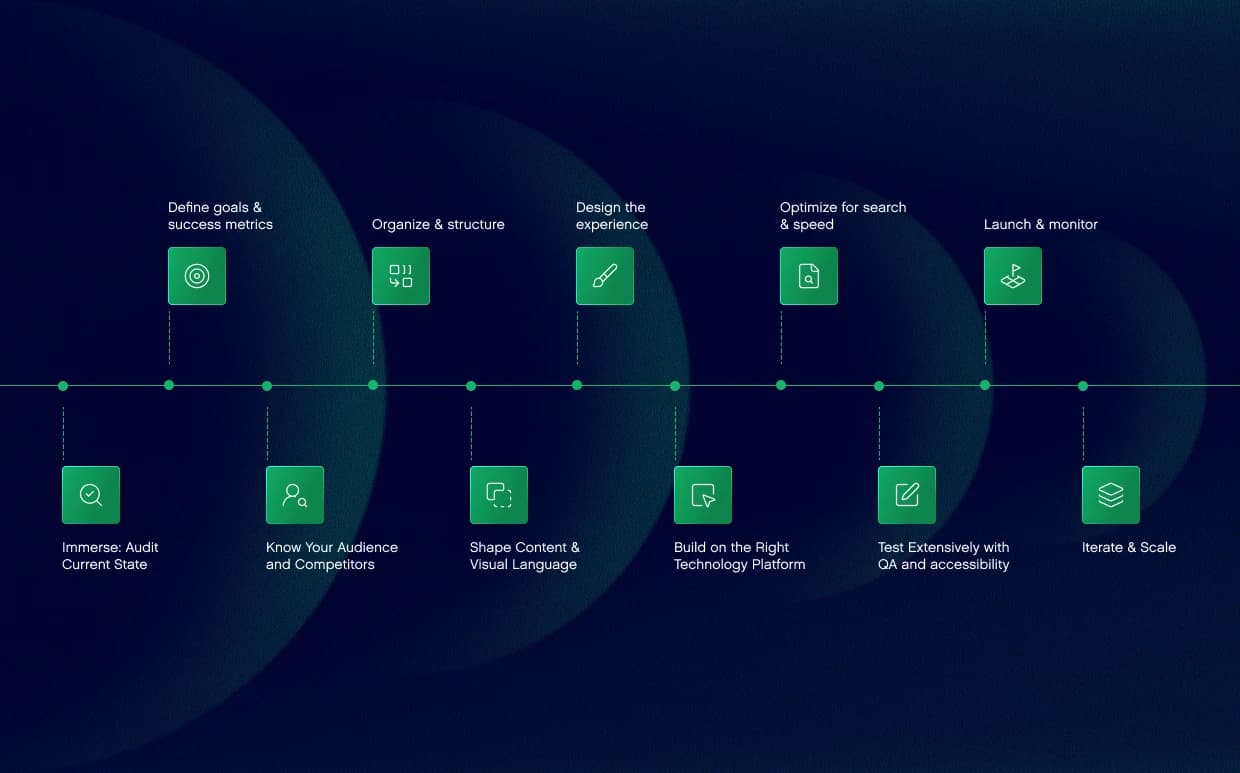
1. Immerse: Audit current state and performance
Auditing your existing website from the ground up sets the tone for a successful project. Review every landing page, blog post, product description and resource to see how they contribute to your business objectives. Audit existing content to identify outdated, irrelevant, or broken elements that should inform your redesign and content improvement efforts. Identify duplication, thin content and pages with poor user engagement. Use Google Analytics and heat‑mapping tools to analyze user behavior, scroll depth and click patterns. Examine your site structure, technical errors and visual consistency. Compile a comprehensive report of your current site so you can make informed decisions about what to keep, remove or improve in the next version. Understanding the strengths and weaknesses of your old site prevents guesswork and ensures your redesign process focuses on the most impactful areas.
Before making any changes, build a clear picture of where you are today. Review analytics over the last 6–12 months to understand traffic patterns, conversion rates, top‑performing pages and where users drop off. Perform a technical audit with tools like Google PageSpeed Insights and identify broken links, slow pages and mobile issues. Evaluate your current content: what resonates with prospects? what’s outdated? This “immersion” phase uncovers the opportunities and risks that will guide your redesign .
2. Define goals & success metrics
Goal‑setting is also where you articulate your website redesign goals, such as expanding into new markets, improving site performance, reducing support tickets or increasing signups from mobile users. Document these as part of your website redesign project plan and tie them back to your business objectives and brand identity. Without clear objectives, it’s easy for a redesign project to drift or become a collection of subjective design opinions. Set expectations about timing, resources and deliverables so stakeholders stay aligned throughout the redesign process.
Website redesigns can easily become endless design exercises unless they are grounded in business objectives. Set SMART goals – for example:
Increase qualified leads by 30 % within six months.
Cut bounce rates to below 35 % across devices.
Improve PageSpeed scores to 90+ for key pages.
Agree on how you will measure success and document these metrics up front. For B2B organizations, revenue per lead, demo requests and engagement with long‑form content are often more meaningful than simple traffic numbers. Clear objectives and well-defined metrics are essential for a successful redesign, ensuring the process delivers both improved user experience and measurable business results.
3. Know your audience and competitors
This phase overlaps with detailed user research and analysis of competitor websites. Survey existing customers and prospects to learn which website elements they find intuitive and which cause friction. Collect user feedback via on‑page surveys, interviews and support conversations. Conduct user testing on your existing site to reveal pain points in your user journey – such as confusing navigation, hard‑to‑find contact information or poor user experience on mobile. Reviewing top‑ranking competitor websites helps you identify industry trends, gaps in your offering and potential ways to differentiate. Compile these insights into a redesign strategy that informs copy, design and functionality decisions. Before initiating the redesign, ensure you clearly understand stakeholder expectations and the benefits a revamped website will bring to your organization.
Deep customer insight is at the heart of every effective redesign. Build out buyer personas using customer interviews, analytics and industry research. Understand their motivations, challenges, decision‑criteria and preferred devices. Benchmark 5–10 competitor sites to see how others in your space position themselves, what design conventions they follow and where the opportunities to differentiate lie. In our own work, we guide teams through Immersion → Creation → Transformation, connecting values to actions and actions to reputation .
4. Organize & structure
Refine your site structure using card sorting or tree‑testing to organize pages into logical groups that align with how users think. Consider your content management system and how easy it will be to add new pages or update existing content post‑launch. A clear site structure improves user experience and helps search engines crawl and index your pages efficiently. The site's structure is crucial for SEO, and any changes made during a redesign should be carefully planned to avoid negative impacts on search engine rankings. Document navigation patterns, categories and URL structures in your website redesign project plan so everyone is aligned when development begins.
Reorganize your content around your user journeys and business priorities. Plan a sitemap that allows visitors to reach any key page within three clicks. For B2B sites this typically includes:
An engaging homepage that captures your value proposition.
Clear pages for your products, services and solutions.
Credibility boosters such as case studies, testimonials and industry expertise.
Resources (blog, whitepapers, events) that demonstrate thought‑leadership.
Contact and conversion points tailored to the buyer’s stage.
Map existing URLs to new locations and plan 301 redirects to protect your SEO equity.
5. Shape content & visual language
A robust content strategy outlines not just what you’ll say, but how you’ll maintain and scale content over time. Use a style guide to codify your brand identity: colors, logo usage, writing style, imagery and tone. Plan for dynamic content blocks and interactive elements that enhance user engagement and provide valuable insights to your visitors. Incorporate user‑generated content, testimonials and case studies to build credibility. Craft pages with clear calls‑to‑action and answer prospects’ questions through FAQs, comparison charts and educational resources. Align all copy with your SEO strategy by weaving in target keywords naturally.
Content is the substance of your digital brand. Audit existing pages, remove duplicates and refresh outdated copy. Plan new material that educates and persuades at every stage of the funnel – from awareness guides to detailed service pages and conversion‑oriented landing pages. Define a consistent tone and voice that reflects your brand personality: professional yet approachable, strategic but never jargon‑heavy. Select a modern color palette, typography and imagery that feel cohesive with your offline brand. When redesigning a website, strategic planning and budgeting are essential to ensure the overhaul aligns with your business goals and delivers measurable results. Remember: the strongest brands are deeply believed in because their story, tone and visuals align .
6. Design the experience
Think about user interface components like buttons, forms, dropdowns and navigation. The design process must balance aesthetic appeal with accessibility and functionality. Follow best practices like the 3‑second rule—users should understand what the page is about and how to take action within three seconds of landing. Adhere to the 7 C’s of web design—Content, Context, Consistency, Clarity, Credibility, Capability and Conversion—to ensure every design decision enhances the overall user experience. The primary goal is to enhance user experience by making the site more intuitive and engaging for visitors. Use design systems and pattern libraries to promote consistency across your site.
Create wireframes for core page types to confirm information hierarchy and user flow. Develop high‑fidelity mock‑ups that incorporate your actual content, brand colors and photography. Design responsively from the outset, ensuring navigation, forms and calls‑to‑action work on mobile as well as desktop. Collect feedback from stakeholders and, if possible, a few representative users. Iterate until the design feels intuitive and expresses the right emotional tone.
7. Build on the right technology platform
When choosing a content management system, assess ease of use, scalability, extensibility and SEO capabilities. Platforms like WordPress, Contentful or headless CMS solutions offer different trade‑offs. A user friendly backend reduces reliance on developers for routine updates, while a composable architecture allows you to swap out components as needs evolve. Integration with analytics, marketing automation and CRM systems is key to measuring key metrics and executing your search engine optimization strategy.
Choosing a platform is about more than templates; it impacts how your team will manage content and data going forward. Options include:
Headless or composable CMS: decouple your front‑end and back‑end for maximum flexibility. Good for scaling and multi‑channel delivery. (We often recommend composable architectures for clients who need complex integrations.)
WordPress or similar CMS: suitable for smaller sites with limited custom functionality.
Custom development: for unique user journeys or integrations.
Consider how the platform supports SEO, security, integration with CRM/marketing tools and your internal team’s ability to update content. Our service offering spans market strategy & insight, brand design & creative, web design & development and next‑gen growth solutions, so we guide clients toward the stack that fits their ambition.
8. Optimize for search & speed
High‑performing pages combine fast site speed with relevant keywords and intuitive design. Apply search engine optimization tactics across every page: internal linking, semantically rich headings, alt tags and accessible navigation. Regularly audit your SEO performance using tools like Google Search Console and adjust based on changes in search engine rankings. Include multimedia—videos, infographics and interactive widgets—but optimize images and code so they don’t slow down your pages. The goal is to satisfy both users and search engines.
SEO isn’t an afterthought – it should inform your site structure, content and performance from day one. Develop keyword‑driven page titles, meta descriptions and header hierarchies. Use schema markup where appropriate. Minify code, compress images and leverage caching/CDNs to achieve sub‑2‑second page loads. Ensure your new URLs are all redirected via 301s from the old structure, and update your XML sitemap and robots.txt before launch.
9. Test extensively with QA and accessibility
Testing should cover functional, performance and accessibility criteria. Use tools like Lighthouse, BrowserStack and WebPageTest to assess site performance, cross‑browser compatibility and mobile responsiveness. Validate forms, shopping carts and payment gateways if applicable. Conduct user testing sessions where participants think aloud while completing tasks on your redesigned site. Capture both quantitative data and qualitative impressions. Iterating based on user feedback ensures your redesigned website meets real needs rather than assumptions.
Before launching, verify that every form submits correctly, every link works and all content displays as intended across browsers and devices. Conduct user acceptance testing with internal teams and a few target‑audience representatives. Fix critical issues and document those that can be tackled post‑launch. Rushing to launch without testing is one of the most common mistakes and often leads to lost leads or reputational damage.
10. Launch & monitor
Create a detailed website redesign project plan for launch day. Include checklists for DNS updates, security certificates, final content proofreading, accessibility validation and load testing. Plan for rollbacks in case critical issues emerge. After launch, track key metrics such as time on page, click‑through rates, goal completions and user satisfaction. Compare these numbers against your old site to quantify improvements. Early feedback can reveal quick wins and inform your ongoing redesign process. Be sure to gather user feedback after launch to guide ongoing improvements and adjustments based on real user insights.
Plan your go‑live during a low‑traffic window and have your technical team on standby. Double‑check analytics tracking, CRM integrations and email notifications. Announce the redesign through your newsletter and social channels to drive initial traffic. For the first month, monitor metrics daily: traffic, conversions, form submissions, bounce rates and search rankings. Expect minor fluctuations; make adjustments based on real‑world data.
11. Iterate & scale
A redesign isn’t a one‑off event – it’s the start of an ongoing optimization cycle. Schedule quarterly reviews to compare performance against your baseline and goals. Use A/B testing to refine headlines, CTAs and layouts. As your business grows, your site should scale with new landing pages, content types and integrations. Continuous improvement turns your website into a strategic asset rather than a static brochure.
Technical Considerations
A successful website redesign goes beyond aesthetics—it requires a solid technical foundation to ensure your site performs optimally for both users and search engines. Start by evaluating your content management system (CMS) to confirm it supports your current and future needs, including scalability, ease of use, and integration capabilities. Prioritize mobile responsiveness, as a significant portion of your audience will access your site from smartphones and tablets. Optimizing site speed is equally critical; slow-loading pages can frustrate users and negatively impact your search engine rankings. Implement best practices such as efficient coding, image compression, and reliable hosting to enhance site performance. By addressing these technical considerations early in the redesign process, you’ll create a website that not only looks great but also delivers a seamless user experience, supports your search engine optimization efforts, and drives measurable business results.
Mobile Optimization
In today’s mobile-centric world, mobile optimization is a cornerstone of any successful website redesign. With the majority of users browsing on smartphones, your site must deliver a user-friendly experience on every device. Responsive web design ensures your layout, images, and content automatically adjust to different screen sizes, making navigation intuitive and enjoyable. Streamline your content and navigation for smaller screens, and optimize images to reduce load times without sacrificing quality. These steps not only enhance user engagement but also improve your search engine rankings, as search engines prioritize mobile-friendly sites in their results. By making mobile optimization a top priority in your web design strategy, you’ll create a site that attracts, retains, and converts users—no matter how they access your content.
Accessibility and Security
Accessibility and security are essential pillars of a modern website redesign. Ensuring your site is accessible means designing for all users, including those with disabilities. Adhering to standards like the Web Content Accessibility Guidelines (WCAG 2.1) helps you create an inclusive experience, from using proper color contrast and alt text to enabling keyboard navigation. Regular accessibility audits can identify and resolve barriers, supporting both compliance and user satisfaction. On the security front, robust measures such as SSL encryption, secure authentication, and regular software updates are non-negotiable. Protecting your site from cyber threats not only safeguards user data but also preserves your brand’s reputation. By prioritizing accessibility and security throughout your website redesign, you build trust, meet legal requirements, and ensure your digital presence is both welcoming and resilient.
Website Redesign Checklist
A comprehensive website redesign checklist is your roadmap to a smooth and effective redesign process. Start by defining clear redesign goals that align with your business objectives and target audience. Conduct thorough user research to understand user needs, pain points, and preferences. Develop a detailed redesign project plan that outlines timelines, responsibilities, and key milestones. Audit your existing content and site structure, then map out improvements for SEO and user experience. As you move through the redesign project, test your site for usability, accessibility, and performance across devices and browsers. Don’t forget to optimize for search engines at every stage, from content creation to technical setup. By following a structured checklist, you’ll ensure your new website meets your redesign goals, resonates with your target audience, and positions your business for long-term success.
Future-Proofing Your Website
Future-proofing your website means building with adaptability and longevity in mind. As web design trends, technologies, and user expectations evolve, your site should be flexible enough to keep pace. Choose scalable platforms and modular design systems that allow for easy updates and the addition of new features. Regularly refresh your content, design elements, and functionality to maintain relevance and drive ongoing user engagement. Stay informed about emerging best practices in web design, accessibility, and performance to ensure your site remains competitive. By investing in a future-proofed website, you create a digital presence that can grow with your business, respond to changing user needs, and deliver lasting value in an ever-shifting online landscape.
Common redesign mistakes — and how to avoid them
Even the best‑intentioned projects can stumble, especially during a site redesign. Understanding the scope, costs, and common pitfalls associated with a full site overhaul is crucial to avoid costly mistakes. Here are mistakes we see most often:
Ignoring SEO and redirects. Changing URLs without proper 301 redirects can wipe out years of search equity. Map every old page to its new destination before launch and monitor Google Search Console for errors.
Forgetting mobile. With mobile traffic making up the majority of visits, neglecting responsive design or page‑speed optimization will frustrate users and hurt rankings. Test on real devices, not just emulators.
Treating design as decoration. Beautiful visuals are important, but they must be rooted in strategy and user insight. Align visuals with your positioning and brand system — avoid redesigns that simply follow trends.
Launching without testing. Seemingly small issues like broken forms, confusing navigation or missing calls‑to‑action can destroy trust. Use checklists, conduct QA with multiple stakeholders and iterate based on feedback.
Ignoring accessibility. Designing for people with disabilities is both an ethical responsibility and a legal requirement in many regions. Use accessible color contrasts, alt tags and keyboard navigation, and ensure your redesigned site meets WCAG guidelines.
Skipping the content audit. Leaving outdated or off‑brand copy in place undermines the user experience. Always perform an audit of existing content and update, consolidate or remove pages that no longer serve your goals.
Understanding Costs and Timelines
The investment required for a redesign varies widely based on scope and complexity. Typical ranges:
Small business or portfolio sites: $5 000–$15 000 if you hire professionals; less if you use templated platforms. Expect a timeline of 4–10 weeks.
Mid‑sized B2B sites: $15 000–$60 000 for custom design, development and integrations. These projects often take 3–6 months and include bespoke UX research, brand positioning and copywriting.
Enterprise platforms: $50 000–$200 000+ for large organizations with complex integrations, multilingual content, e‑commerce or proprietary platforms. Timelines can extend 6–12 months to accommodate stakeholder reviews and custom engineering.
A full website overhaul is appropriate when your goals include significantly improving user experience, updating outdated design, or enhancing SEO. Strategic planning and thorough testing are essential before undertaking such a comprehensive update.
Don’t forget to budget for ongoing maintenance and growth. After launch, set aside funds for performance updates, security patches, content creation and continuous experimentation. In our web design and development practice we provide flexible support and maintenance packages to ensure clients’ sites continue to evolve.
DIY vs. Professional Help
Thanks to modern builders, DIY platforms like Squarespace, Wix and WordPress.com make it possible to launch a decent site without code. They’re suitable if you’re just getting started or have a single product/service, and if you can dedicate time to learning the platform and creating content. However, once you need custom functionality, CRM integrations, marketing automation or a scalable content model, partnering with professionals saves time and reduces risk. Working with experts ensures that both the client and the web development team are on the same page, with clear communication and alignment on project goals and scope. Our multidisciplinary teams combine market strategy & insight, brand design & creative, web design & development and next‑gen growth solutions, giving B2B clients a single partner across their entire digital ecosystem.
Post‑Launch Best Practices
A new site is just the beginning. To maintain momentum:
Monitor analytics. Set up dashboards to track traffic sources, conversion rates, dwell time and behavioral flows. Compare against your baseline and goals established before the project.
Gather feedback. Use surveys, user testing sessions and direct outreach to understand how real visitors perceive your new site. Look for pain points and opportunities.
Keep content fresh. Publish thought‑leadership articles, case studies and industry reports regularly to improve SEO and establish authority. Use your blog or resources centre as an engine for inbound growth.
Maintain security and performance. Apply updates to your CMS, plugins and server environment. Optimize images and code as you add new pages. Consider a maintenance retainer with your agency partner.
Leverage AI and automation. Emerging tools like generative AI, chatbots and predictive analytics can enhance personalization and efficiency. Our next‑gen growth solutions team leverages AI and human insights to help clients scale and operate more efficiently.
Analyze user behavior. Use heatmaps and session replays to see how visitors interact with your new site. Understanding user behavior through analytics and heatmaps is crucial for making informed design decisions and optimizing conversion strategies. Identify common drop‑off points, confusion triggers and features that encourage user engagement. Align your insights with your original redesign goals and adjust accordingly.
Plan incremental improvements. A successful website is never finished. Use a backlog to prioritize enhancements such as new content modules, micro‑interactions, improved mobile responsiveness or additional landing pages targeting different personas.
Refresh or full redesign?
Not every site needs to be rebuilt from scratch. A refresh updates colors, typography and content without changing core structure – suitable when your site performs well but looks dated. A complete redesign is necessary when your technology is outdated, mobile experience is poor, or your business model has evolved significantly. When you redesign a website, it involves a comprehensive process that goes beyond visual updates, requiring careful evaluation of goals, technology, user experience, and business objectives. Most companies benefit from periodic refreshes between major redesigns every 3–5 years.
FAQ
How should we approach redesigning an existing website?
Start by auditing your existing site and gathering user feedback to understand what works and what doesn’t. Define clear redesign goals that support your business objectives, then research your target audience and competitors. Map out a new site structure, develop a robust content strategy, design responsive mock‑ups and build on a scalable content management system. Throughout the redesign process, optimize for search engines, test thoroughly and plan for post‑launch improvements.
Following a structured, step-by-step website redesign process is essential to ensure a smooth and effective overhaul of your site.
What are the 7 C’s of a website?

The 7 C’s of web design are guiding principles that ensure a balanced and effective digital experience:
Content – Provide valuable, relevant information that answers users’ questions.
Context – Present information in a logical, user‑friendly layout tailored to your audience.
Consistency – Maintain a cohesive visual and structural style across all website pages.
Clarity – Use concise copy and intuitive navigation to avoid confusion.
Credibility – Build trust with proof points like testimonials, case studies and certifications.
Capability – Ensure your site performs well across devices and platforms.
Conversion – Design pages and landing pages that guide users toward taking action.
What is the 3 second rule in web design?
The 3 second rule states that visitors should understand what a page is about and what action you want them to take within three seconds of landing. This emphasizes clear messaging, prominent headings, concise design elements and fast loading times. Adhering to this rule helps reduce bounce rates and improve user experience.
Can ChatGPT design a website?
Large language models like ChatGPT can assist with brainstorming layouts, generating copy, suggesting content strategy and even producing sample code snippets. However, a successful website redesign requires multidisciplinary collaboration between strategists, designers, developers and SEO specialists. AI tools can augment your team but cannot replace expert human judgement, testing and creative direction. At Matic, we integrate AI within our next‑gen growth solutions to accelerate research and ideation, but our human experts steer the redesign project from start to finish.
Choosing the Right Partner
DIY platforms work well for simple sites when budget is tight, but complex B2B organizations often require professional support. At Matic, our cross‑disciplinary team brings together strategists, designers, engineers and AI specialists. We immerse ourselves in your world, co‑create a blueprint and build digital experiences that scale. Our market insight, branding expertise and full‑stack engineering capacity – from user journeys and UX/UI design to performance optimization and composable CMS – allow us to deliver websites that aren’t just beautiful but strategically aligned with your growth ambitions.
Ready to Transform Your Digital Presence?
Websites are never “done.” They evolve as your market shifts, technologies advance and your story deepens. If you’re ready to turn your site into a strategic advantage, let’s talk. Our team can help you uncover hidden opportunities, shape a compelling digital brand and build an experience that converts visitors into believers.


About Matic
We're a B2B transformation agency creating strategic advantage through branding, websites, and digital products.